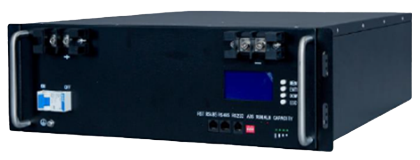











Modular, intelligent, and outdoor-ready cabinets
As networks evolve to support 5G and high-density data demands, ensuring stable, uninterrupted power at remote and harsh environments becomes increasingly complex. Traditional power systems often lack modularity, environmental resilience, and intelligent monitoring—putting uptime and equipment safety at risk.
PROSE delivers integrated indoor and outdoor power cabinet solutions with built-in UPS, smart environmental sensors, and scalable battery configurations. Our systems combine robust structural design (IP55/65), flexible AC/DC power conversion, and real-time monitoring to ensure performance under any condition. Every cabinet is engineered for efficient cooling, fast deployment, and long-term durability.
With PROSE, operators gain peace of mind through reduced downtime, streamlined maintenance, and improved energy efficiency. Our modular, fully integrated solutions support rapid 5G rollout, remote monitoring, and compliance with telecom-grade reliability standards—empowering your network to grow securely and sustainably.
The integrated power cabinet is mainly used for wireless communication base stations, including the new generation of 5G systems, communication/network integrated services, access/transmission exchange stations, emergency communication/transmission, etc.
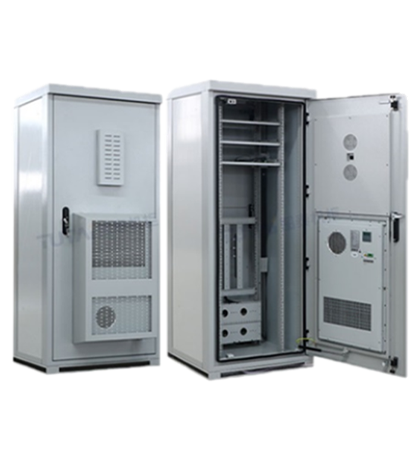
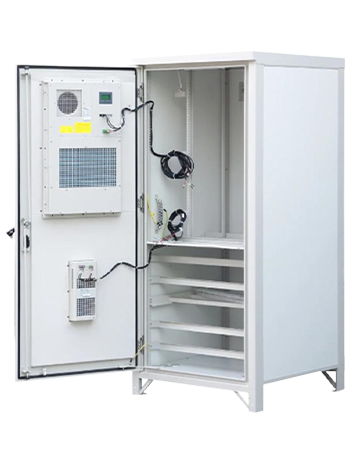
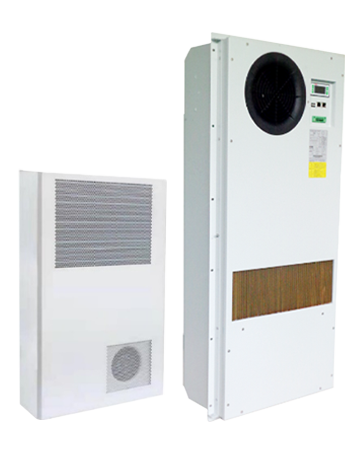
An outdoor power cabinet is an enclosure specifically designed to operate in external environments. It serves to protect power equipment, communication hardware, and other electronic components from environmental hazards. Key attributes include robust structural engineering, high protection ratings, environmental resilience, safety features, and more.
These cabinets are typically made from durable materials such as galvanized steel, stainless steel, or aluminum alloy, offering strong resistance to corrosion and oxidationmaking them ideal for prolonged outdoor use. With protection levels of IP55, IP65 or higher, they effectively guard against dust, water, and humidity. Cabinets with higher ratings can even withstand heavy rain or sandstorms.
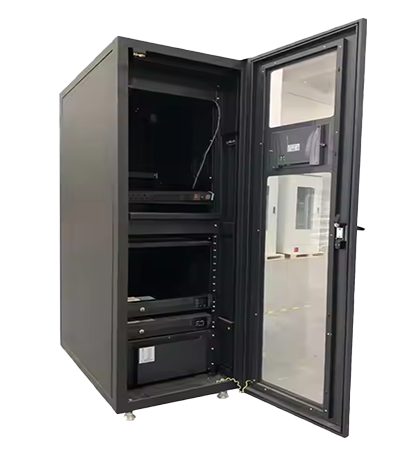
In contrast, an indoor power cabinet is generally installed in climate-controlled rooms, where temperature and humidity are stable, and environmental exposure is minimal. These cabinets often come pre-equipped with monitoring displays that provide real-time information on power consumption and system status.
Figure 1 Outdoor Power Cabinet
Figure 2 Indoor Power Cabinet
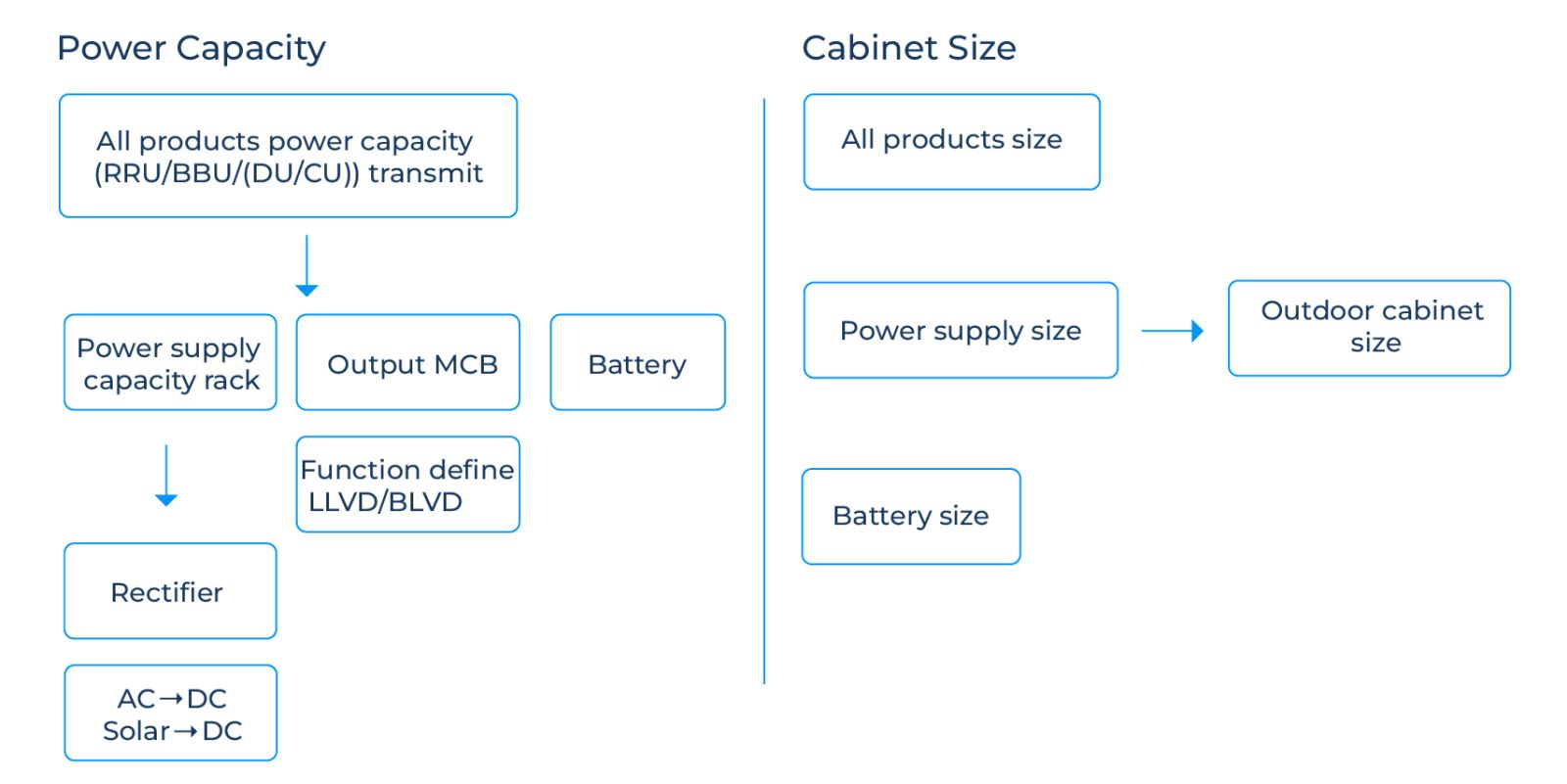
Input:
List of device dimensions (height, width, depth)
Output:
(1) Cabinet Footprint (Base Dimensions)
• Determined by the largest device depth
• Includes additional space for cable management and ventilation channels
(2) Cabinet Height
• Based on the total height of all installed devices, including power supply units and batteries
(3) Load Capacity Design
• Calculated from the total weight of all components installed inside the cabinet
(4) Cooling Strategy
• Depends on the cumulative heat output of all active devices
(5) Grounding System
• Defined by the number and type of electronic components requiring grounding
Input:
List of devices with power ratings (Voltage and Current)
Output:
(1) Power supply unit
• Must support the full power demand of all installed devices
• Include a power margin of 20% to 30% for system stability
• Rectifier selection depends on input source (AC-to-DC or Solar-to-DC)
• N+1 redundancy recommended for high availability
(2) Miniature Circuit Breakers (MCB)
• Output MCBs sized according to device current ratings
• Input MCBs (AC) based on total power load and input voltage
• Battery MCBs dimensioned for the maximum charge/discharge current
• LLVD (Low-Voltage Load Disconnect) and BLVD (Battery Low Voltage Disconnect) supported if needed
(3) Battery quantity
• Defined by backup time requirements and total power draw in case of outage LLVD (Low-Voltage Load Disconnect) and BLVD (Battery Low Voltage Disconnect) supported if needed
Figure 3 Power Cabinet Design Process
The monitoring system is a critical component for ensuring the reliability, safety, and operational continuity of outdoor and indoor cabinets. It continuously tracks environmental and physical parameters and provides real-time alerts to prevent equipment failures, unauthorized access, or hazardous conditions.
(1) Water Leak Detection
• Sensors placed at the base of the cabinet detect the presence of moisture or flooding.
• Triggers alerts to prevent short circuits or equipment damage due to water ingress.
(2) Door Status Monitoring
• Magnetic or mechanical sensors monitor whether the cabinet doors are open or closed.
• Can be integrated with security systems to detect unauthorized access attempts or vandalism.
(3) Smoke Detection
• Early-warning smoke sensors are installed inside the cabinet to detect fire hazards.
• Helps prevent equipment damage due to overheating or electrical faults.
(4) Temperature & Humidity Monitoring
• Sensors measure internal ambient temperature and relative humidity.
• Triggers alerts when thresholds are exceeded, enabling preemptive action before thermal shutdown or condensation occurs.
(5) Power System Alarms
• Monitoring of AC/DC voltage levels, current flow, rectifier/battery status, and backup power availability.
• Ensures stable and redundant power operation.
(6) Access Control Integration
• Optionally linked with card readers or biometric systems to log and control physical access.
An advanced Dynamic Environment Monitoring System can be integrated for intelligent management and remote supervision. It typically includes:
• Centralized Monitoring Unit (CMU) that collects and transmits sensor data
• Real-time alarms and event logging
• Remote access via web, SNMP, or mobile application
• Automated reports for maintenance and compliance
• Predictive analytics for proactive system health checks
Benefits:
• Reduces downtime and service interruptions
• Enhances asset protection and personnel safety
• Enables remote and automated supervision
• Supports compliance with telecom site regulations and SLAs
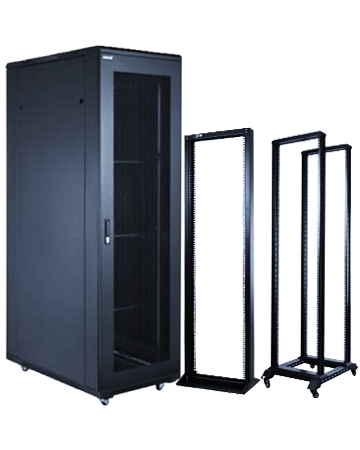
Figure 5 Indoor Cabinet
Application
Indoor use, ventilated
Feature
19” standard rack
Heavy load frame and rack up to 30kg per unit (44.45mm)
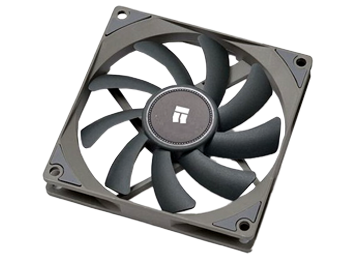
Good ventilation design with fans pre-assembled
Transparent air duct design from up to down, front to back
Perfect inlet and outlet hole design
Typical Size
600x700x2000mm, 600x800x2000mm, 600x1200x2000mm, etc.
The indoor power cabinet is typically constructed using powder-coated galvanized steel, offering excellent corrosion resistance and long-term durability.
When integrated into a facility with an existing forced air cooling system, indoor cabinets can be deployed in highdensity configurations, contributing to efficient thermal management across the equipment room. For simpler setups, cabinets equipped with passive ventilation grilles or low-noise fans offer a cost-effective cooling solution while minimizing design complexity and potential failure points—particularly when the room is already well-ventilated.
To aid in maintenance and monitoring, indoor cabinets are often fitted with vented or transparent front and rear doors, allowing for visual inspection of internal equipment without compromising safety or protection.
A customized cable management system includes integrated cable channels, adjustable brackets, grounding strips, and modular routing options to simplify installation and minimize electromagnetic interference—a critical factor in sensitive indoor IT environments.
Mounting rails are fully compliant with the 19-inch rack standard, supporting a wide range of power, IT, and network equipment.
Fire-retardant construction materials and optional smoke detection systems further enhance compliance with indoor safety standards.
The cabinet's smooth, neutral-toned exterior is designed to aesthetically complement office or data center environments, avoiding the industrial appearance typical of outdoor enclosures.
Overall, indoor power cabinets emphasize flexibility, ease of integration, and compatibility with IT infrastructure, while ensuring reliable power distribution and operational safety.
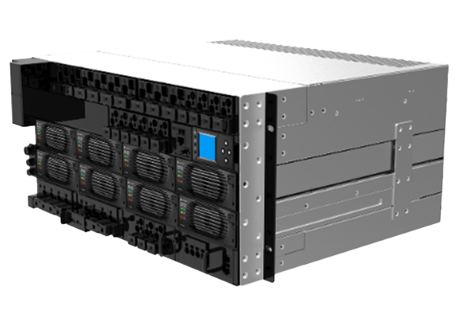
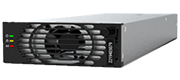
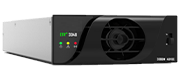
Figure 8 48V Power Supply
AC to DC Rectifier
Solar to DC Rectifier
Monitor Unit
Application
Pre-assembled in the cabinet, Provide -48V DC power to the devices
Feature
High-Efficiency Conversion
Wide Input Voltage Range
Stable Output and Low Ripple
Multi-Protection Mechanisms
Thermal Management and Reliability
Typical Power capacity
From 3000W to 48000W.
48V communication power supply adopts high frequency switching technology, and the conversion efficiency reaches 85-95%, which significantly reduces the energy loss.
The input voltage is compatible with global grid standards and can be used in different regions.
Stable 48v DC output, output voltage deviation ≤±1%, excellent resistance to voltage fluctuations and harmonic interference to meet the requirements of precision equipment (such as communication equipment, industrial control systems).
Input and output protection ensures the safety of the equipment, and the built-in sensor can effectively control the load output in abnormal conditions, reducing the occurrence of accidents.
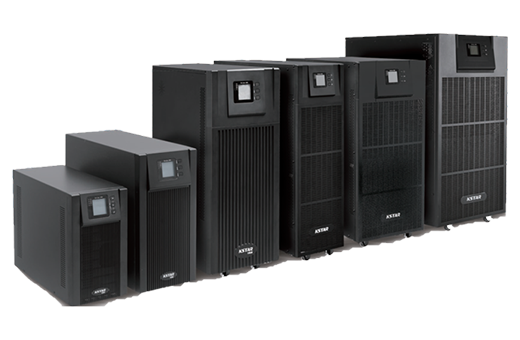
Figure 9 48V Power Supply
Application
Pre-assembled in the cabinet, keep the power smooth and uninterrupted
Feature
Emergency Power Supply
Power Quality Optimization
Seamless Switching and Isolation
Mixed rectifier support
Real time monitor for PSU status
Typical Power capacity
From 3000W to 48000W.
• Power Failure Protection
When mains power is suddenly interrupted, the UPS immediately switches to battery power (millisecond-level response), providing continuous electricity to devices (ranging from minutes to hours) to prevent data loss or equipment downtime.
• Buffer Time
It supports devices in completing a safe shutdown or waiting for generator startup before the backup power is depleted.
• Voltage Stabilization
Eliminates voltage fluctuations in the mains power, delivering stable voltage to protect sensitive electronic components.
• Filtering
Suppresses grid disturbances such as surges, spikes, and harmonics, preventing equipment damage from electrical noise.
• Frequency Correction
Certain UPS systems can adjust input power frequency to ensure stable operation of precision equipment.
Using "online mode" or "dual-conversion" technology, UPS isolates grid pollution and achieves zero-delay switching between mains power and battery power. This is critical for scenarios demanding ultra-high-power continuity, such as operating rooms or semiconductor production lines.
Figure 12 MCB (Miniature Circuit Breaker)
1-125A current capacity
6kVA or 10kVA short-circuit current available
Available current
4A/6A/10A/16A/20A/32A/40A/50A/ 63A/80A/100A/125A
Figure 13 SPD (Surge Protective Device)
Single phase or tri-phase available
Wave 8/20s
Discharge current available
6kA/10kA/25kA
MCB (Miniature Circuit Breaker) is a protection device in power systems that automatically cut off current in the event of a circuit failure (such as overload, short circuit, leakage, etc.) to prevent equipment damage, fire, or personal injury.
In the power cabinet solution, both input AC and output DC circuit are use MCB to protect the device in good condition.
SPD (Surge Protective Device) is a device used to protect electrical and electronic equipment from transient overvoltage (such as lightning strikes, operating overvoltage, etc.). Its core function is to ensure the safe and stable operation of the system by limiting the voltage amplitude and releasing the inrush current.
SPD is only for the input end, such as AC input and battery input protection, keep the power system safe avoid the lightning strikes.
Temperature & Humidity Sensor
Smoke Sensor
Door Sensor
Water Leaky Sensor
Environmental sensors are used to monitor the environment around the device, with the RS485 and dry contact communication ports to collect real time data and send to the monitor room, early warning the problem and reducing the accidents.
*BLVD is designed to protect batteries from excessive discharge. When the battery voltage drops below a certain threshold, the BLVD will disconnect the battery from the load. This prevents the battery from being discharged too far, which can damage the battery.
*LLVD is designed to protect loads from damage caused by low voltage. When the voltage of the load drops below a certain threshold, the LLVD will disconnect the load from the battery. This prevents the load from being damaged by low voltage.

Reducing footprint and costs while improving efficiency through a multi-tenant outdoor power cabinet solution for shared telecom infrastructure in Manila, Philippines.

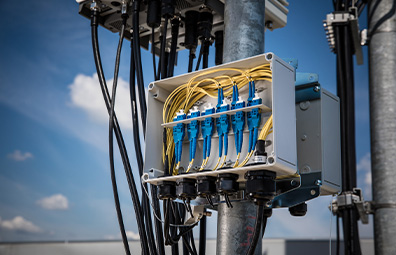
Boosting urban connectivity with FTTA technology in Bandung
Welcome! Let us know how we can help, and we'll guide you to the right information or team.
You can fill out our Contact Sales Form here. A representative will contact you soon.
You can fill out our Technical Support Form here. A representative will contact you soon.
You can fill out our General Inquiries Form here. A representative will contact you soon.
You can find our Global Footprints here.
The default scope is the Product Category (more than 1391 products).
For non-product materials (support documents, press releases), select Search Website.